
Elias Chacour – do you know of him?
He’s a prominent Palestinian-Arab-Israeli peace activist, educator and retired Archbishop of Galilee in the Greek Catholic Church [Melkite]
He is widely known for his lifelong commitment to non-violence and reconciliation between Palestinians and Israelis. He is often simply called Abuna [Arabic for father]
Key Accomplishments and Mini-Biography
- Education for Peace: He founded the Mar Elias Educational Institutions [MEEI] in Ibillin, Galilee. This educates thousands of students from diverse backgrounds – including Christians, Muslims, Jews and Druze – with the goal of fostering mutual respect from a young age.
- Peace Advocacy: On account of his work for tolerance and co-existence, he has been nominated for the Nobel Peace Prize three times [1986, 1989, 1994]. He received the Methodist World Peace Award [1994] the Japanese Niwano Peace Prize [2001] and was Israel’s Man of the Year 2001
- Historical Appointment: In 2006, he became the first Israeli citizen to be appointed as a bishop of the Greek Catholic Church, eventually serving as the Archbishop of Galilee
- Best-Selling Author: He wrote several influential books, most notably Blood Brothers [1983 – now in 28 languages], which movingly and entertainingly describes his experiences as a Palestinian Christian and his philosophy of non-violence. This was followed by: We Belong to the Land [1990] and Faith Beyond Despair [2002].
- Identity: He often describes himself as a “Palestinian Arab Christian Israeli” viewing his multifaceted identity as a “beautiful mosaic” for peace building.
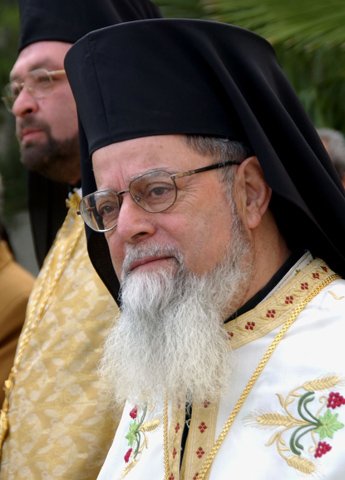
If you have read any of his books [or even if you haven’t] and feel you would like to see him, he hopes to be visiting Devon early this May as a guest of Desktops For Peace: a not-for-profit, gift aid registered organisation centred in Kingsbridge.
The Desktops for Peace website will publish further concise but detailed information on when and where you can meet him during his week’s stay in the South Hams. Of course we have to reckon that there is a possibility that the current Iran/Lebanon war may require our plans to be postponed. Again the Website will be your reference guide and information point
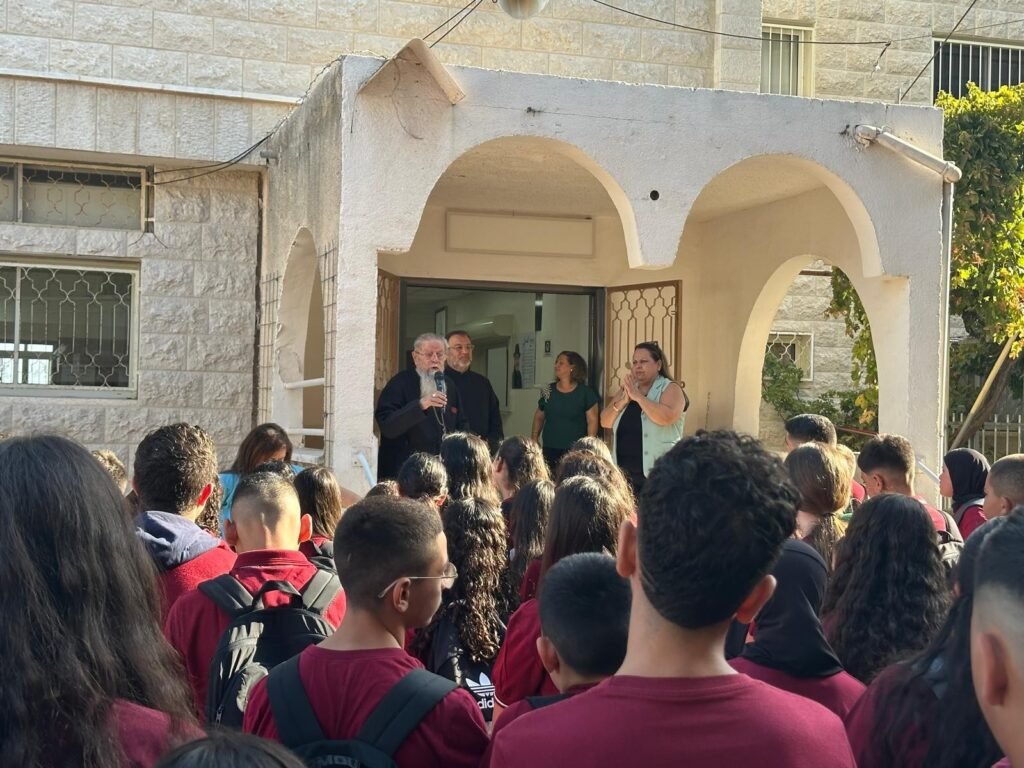
MEEI [Mar Elias Educational Institution]
These wonderful ‘peace’ schools [for ‘all faiths or none’] have in recent years faced continual disruption and pressures caused by a massive reduction in Israeli government support [‘to pay for the war’]. Security tensions and social instability have greatly exacerbated all this. However, amazingly, MEEI still ranks in the top 10% of all schools in Israel. Recently they ranked 4th [out of 1074] for the ‘Bagruts’ English results, quite incredible given they receive a small fraction of the funds that Jewish schools receive from the Education Ministry.
Elias Chacour went to his first parish in Galilee with the warning that the situation wasn’t easy, so maybe try it for a month? In the 1940’s Ibillin’s social fabric had been torn apart, with Moslems, Greek Orthodox and Melkite etc Christian places of worship “slammed together” on a hilltop. Families and neighbours were at war. The aggressive Responsible told him he wasn’t wanted there. His divisive attitude massively aggravated everything.
Abuna went quietly about his work, visiting everyone he could, but realised he needed help. Eventually he asked 3 nuns to come to Ibillin. Their work with the sick, especially the children, began to open doors. So one Palm Sunday, when the church was unusually packed, he locked the doors saying “I have tried to unite you but failed as I’m only a man – but there is one who can: Jesus Christ. He gives the power to forgive. But if you will not forgive, we’ll stay locked in here. You can kill each other and I’ll celebrate your funerals gratis”.
A long agonising silence followed until, eventually, the feared policeman [eldest of 4 warring brothers] stood up, begging forgiveness. He strode down the aisle to embrace Abuna, both men in tears. Soon the whole congregation was reconciling in love, joy and peace. They went out on the streets with Abuna declaring Easter celebrations early.
Right from the start the building of the MEEI schools was a struggle. Firstly Abuna had to apply for a building permit. This was turned down because the ‘site wasn’t earmarked for the purpose’ though it had belonged to their church for 300 years before Israel existed. As everything was otherwise ready he decided to grasp the nettle and do without a permit. Then the police arrived and demanded to see his permit. When he told them he had not got one. They asked: ‘But how are you building without a permit?’ Abuna replied: ‘I have never used a permit for building I have used sand, cement and water.’ The police grew angry saying: ‘That is not how to behave in a civilised country’ Abuna’s response was: If this were a civilised country a permit would have been given.
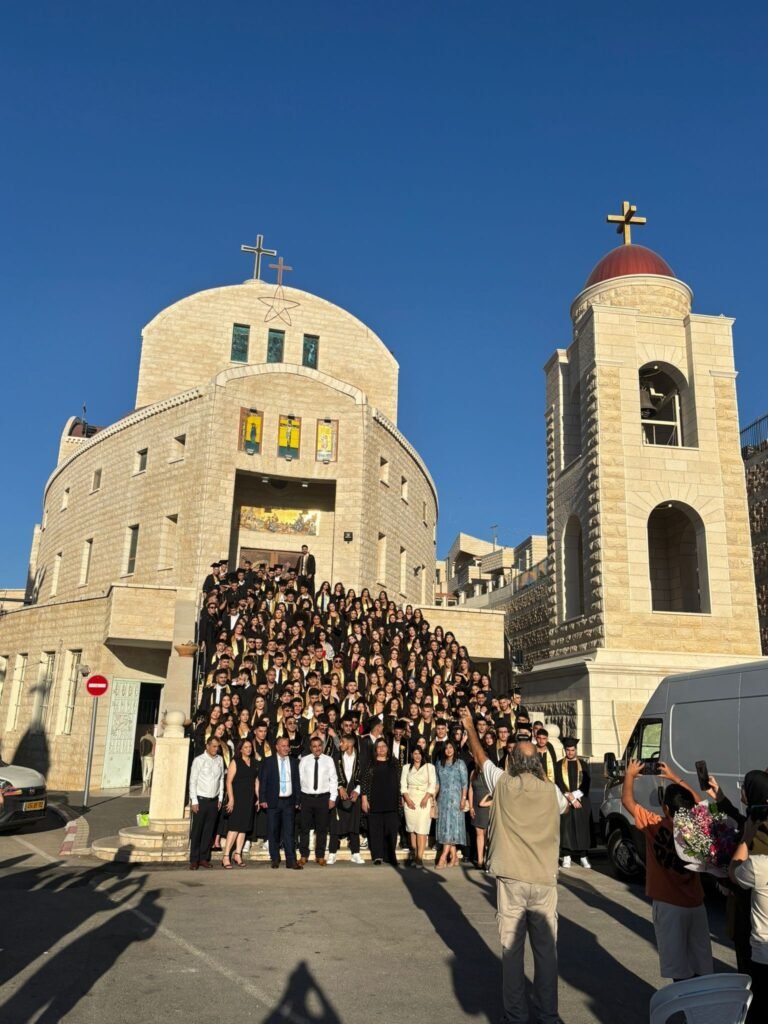
The schools grew. When they reached 1000 pupils [from 350] more buildings were needed. Abuna was told he would get the ‘permit’ – in time! Well 5 years later he went to Washington. He knocked on James Baker’s door [secretary of state]. Susan Baker answered and asked who he was. He replied: “Madam, I am another man from Galilee” “Do you have an appointment?” she asked, “Madam, we men from Galilee never have appointments, we just appear”. She promised to talk to James but had to get back to her Bible study group. When Abuna heard they were doing the Sermon on the Mount, he offered to explain its relevance to him as a man from Galilee near that very ‘Mount’.
In no time James Baker and his wife became prayer partners with Abuna [by phone when Abuna returned to MEEI]. James then took a letter to Yitzhak Shamir [then Israeli PM] requesting the permits, which were of course granted.
Three months later, Abuna was informed that Shimon Peres [Israeli Foreign Minister] wished to give a lecture at MEEI, after which he told Abuna “From now on no need to go to Mr Baker with any problem. I will be your ambassador myself.” He turned out to be indeed an excellent one when he ‘asked’ Rubinstein [Education Minister] to visit MEEI discreetly and see what was happening. Rubinstein came with a formal and offcial proclamation that MEEI was now a recognised university college. This had in fact been opened 6 months earlier and also was soon to be recognised by the Union of American Universities.
Minister Rubinstein then wrote to Abuna saying ‘Now you have recognition, would you be prepared to accept as students some young Jews who have finished their military service?’ Abuna wrote: ‘What was I to say? I, a refugee – I have been deported. My village is in ruins and now I am asked to accept some Jewish soldiers.’ What he wrote was: ‘You say you would like to send some ex-soldiers to study in my college, I beg you: send me the whole Israeli army! I would like to hold a discussion with them on two questions: how they can get rid of their weapons, and how are they to win over the hearts of Palestinian children with a smile and a spirit of sharing?’